The Missions North of the Danube
~ Tuesday, January 11, 2022 ~
The standard narrative places the Christianization of Moravia and Bohemia at 863 CE, with the arrival of the Byzantine missionaries Cyril and Methodius at the invitation of Prince Rastislav. This is accurate in outline. But Rastislav’s letter to Constantinople does not say what the standard narrative implies. It says his people had already rejected paganism. Cyril and Methodius arrived not at the beginning of Christianity in this region but well into its middle.
The Annales Fuldenses, the Carolingian royal annals, record something that is seldom given the attention it deserves. In the year 845, fourteen Bohemian dukes traveled to Regensburg and were baptized there. This is the first documented Christian contact in Bohemia proper. It predates the arrival of Cyril and Methodius in Great Moravia by eighteen years.
The significance of this entry is not that it proves Christianity was well established in ninth-century Bohemia — fourteen dukes represent a political gesture as much as a religious one. The significance is that it establishes Christian contact was occurring before the official mission, through Frankish channels rather than Byzantine ones, well before the event that tends to receive all the narrative weight.
What Rastislav’s request reveals
When Prince Rastislav of Great Moravia wrote to Emperor Michael III in Constantinople around 862–863 to request Byzantine missionaries, his letter — as preserved in the Slavonic Life of Methodius — states explicitly that his people “had already rejected paganism and adhere to the Christian law.” His request was specifically for priests who could conduct the liturgy in Slavic rather than Latin, and for missionaries who could counter the influence of Frankish clergy already operating in Moravia.
The Cyril-Methodius mission was not an evangelization into pagan territory. It was a reorientation of an existing Christian population — and it was as much an ecclesiastical and political intervention as a religious one. The Diocese of Passau held canonical jurisdiction over Moravia before 863; the arrival of Byzantine missionaries was partly a challenge to that jurisdiction, carried out at the request of a prince seeking ecclesiastical independence from his Frankish neighbors.
The documented century before 863
The 845 Regensburg baptism of Bohemian dukes was preceded by Carolingian ecclesiastical activity in Moravia. Archbishop Adalram of Salzburg consecrated a church in Nitra for the Slavic prince Pribina in 827 or 828 — identified in the scholarly record as the first church of the Western and Eastern Slavs whose consecration is documented in the written sources. In 831, Bishop Reginhar of Passau baptized the Moravians, an event recorded in the same Carolingian annals.
These are not shadow events or marginal notations. They appear in the same annals that record political and military affairs of the period, and they indicate that the Diocese of Passau understood itself to have pastoral responsibility for this territory decades before Cyril and Methodius arrived.

The peregrini and the eastern edge
Alongside the Frankish diocesan missions, and somewhat earlier, Irish and Scottish monks traveled east as part of the distinctively Irish practice of peregrinatio pro Christo — wandering as spiritual exile, without institutional assignment and without a fixed destination. Columbanus left Bangor Abbey for Burgundy around 590, founded Luxeuil and eventually Bobbio in northern Italy, and his disciples spread through France, Germany, and Switzerland. Kilian of Würzburg was martyred in Franconia in 689 while missionizing in Germanic territory east of the Rhine.
Virgil of Salzburg, an Irish priest who served as Bishop of Salzburg from 766 until his death in 784, missionized in Carinthia and sent missionaries eastward toward Hungary — documented in hagiography, eighty years before the arrival of Cyril and Methodius, placing Irish-tradition Christian activity in the eastern Alpine and Pannonian zone well before the official Byzantine mission.
The excavations at Mikulčice-Valy, the largest Great Moravian site on the modern Czech-Slovak border, have revealed eleven ninth-century church structures and over 2,500 inhumation burials. The architectural analysis identifies traces of Celtic and Anglo-Saxon influence alongside Byzantine and Frankish forms. The site is not a pure product of any single missionary tradition. The people who built those churches had been in contact with more than one line of Christian practice.
Where the forests are dense
In Celtic and Irish hagiographic literature, the destination of the wandering monk is described in consistent terms across a range of texts: a place set apart from human settlement, characterized by dense forest and running water. The specific phrase varies from text to text, but the landscape is consistent — a hill country with springs, wooded, at a remove from populated routes. The monks who followed this tradition were not looking for political centers or episcopal cities. They were looking for something else.
The highland country of western Moravia and Bohemia — the Vysočina region, the hill country lying between Brno and the Bohemian border — matches this description without requiring distortion. The land is real, and its character matches the landscape the hagiographic texts describe.
Whether figures traveling under no bishop’s authority, following descriptions of a place they had heard about or dreamed of, reached this region before the Frankish and Byzantine missions consolidated around the major centers — this is a question the documentary record cannot answer. The records were kept by the institutions, and institutions did not record what moved outside their boundaries.
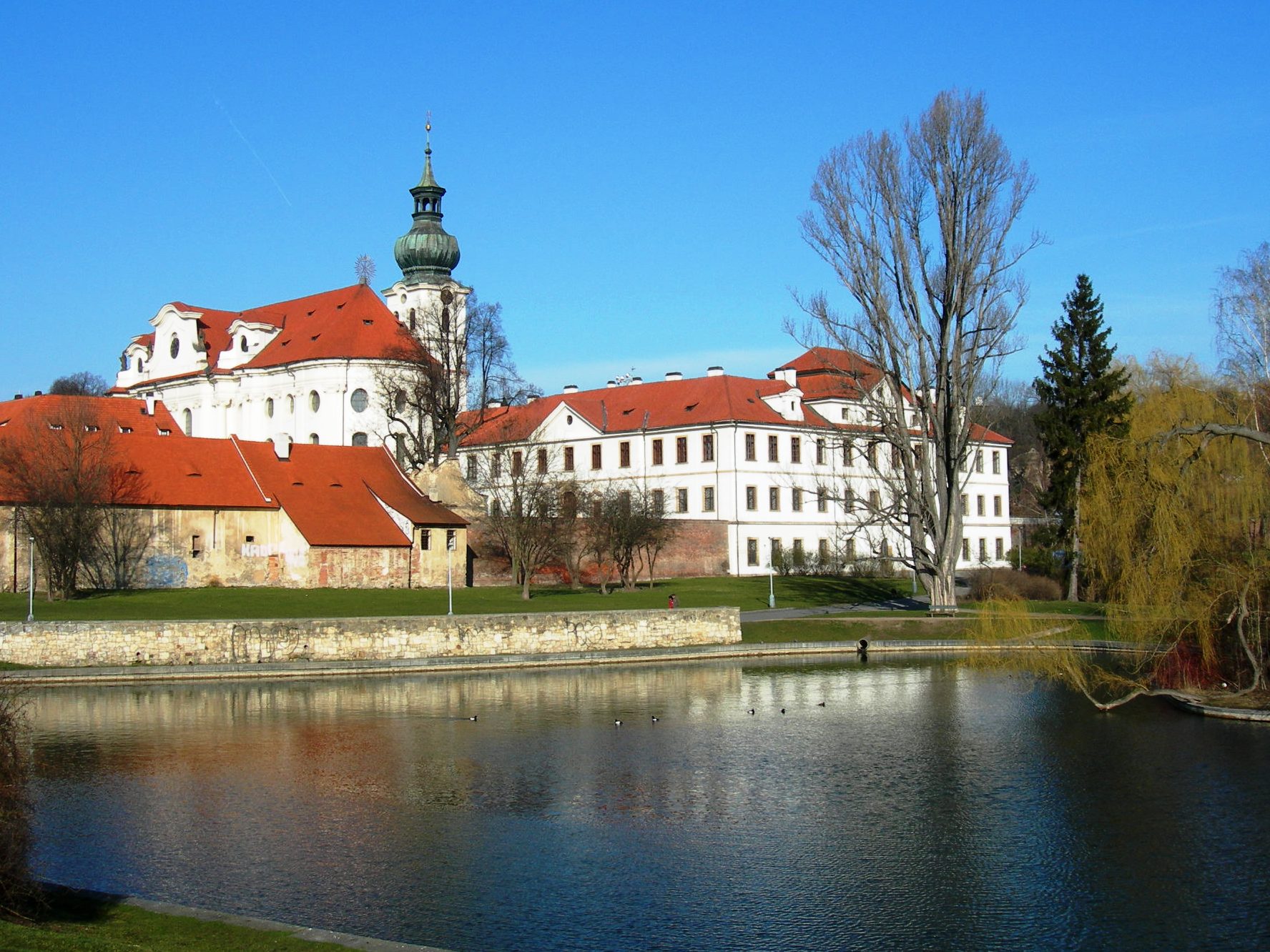
What is occasionally preserved is an edge: a detail, a line, that arrived in an archive without explanation. Brevnov Monastery — founded in 993 CE by Adalbert of Prague, the first Benedictine house in Bohemia — holds miscellaneous archival material accumulated over many centuries and preserved, imperfectly, through the Hussite wars, the Thirty Years’ War, and later expropriation. Among fragmentary chronicle material in that archive, Bishop encountered a single undated line in a hand that does not match its surrounding documents: sepulcrum magistri, extra muros, signo tertii decimi signatum. The grave of the teacher, outside the wall, marked with the thirteenth sign. No name. No location. No surrounding context that identifies the subject.
Bishop cannot date the fragment, cannot identify the teacher, and cannot determine whether the burial site it describes was within the monastery’s own grounds or somewhere further into the landscape. He notes it as a detail that belongs in the record, and sets it alongside the others.
In this series
- The Lists That Don’t Agree
- The Seventy and the Problem of Names
- Paul’s Argument
- What Nag Hammadi Did to the Record
- The Number Beyond the Count
- The Grave of the Teacher — the Břevnov fragment revisited; what the convergence implies
- The Road That Carried Everything — the amber corridor and the peregrini; the route the missionaries used
Sources
- Annales Fuldenses. Ed. Friedrich Kurze. MGH SS rer. Germ. 7. Hannover, 1891. (Primary source: 828 Nitra, 831 Moravia, 845 Regensburg.)
- Cosmas of Prague. Chronica Boemorum (c. 1119–1125). Trans. Lisa Wolverton. Washington: Catholic University of America Press, 2009.
- Třeštík, Dušan. Počátky Přemyslovců: Vstup Čechů do dějin. Prague: NLN, 1997.
- Jonas of Bobbio. Vita Columbani (c. 640 CE). Primary source on the Irish peregrini network.
- Mikulčice-Valy excavation documentation. Czech Academy of Sciences, Institute of Archaeology Brno (ongoing since 1954).