The Folios That Are Not There
~ Monday, November 8, 2021 ~
Beinecke MS 408 currently contains approximately 240 pages. The original manuscript, by quire analysis, contained approximately 272 — leaving roughly 32 pages unaccounted for. Some are gone by deterioration. Some were cut. Two entire quires have no trace at all. This article is about what is absent.
A quire is the structural unit of a manuscript codex. Take four bifolios — four sheets, each folded once — and stitch them together at the fold, and you have a standard eight-leaf, sixteen-page quire. The pages of a codex are produced and read by working through the quires in sequence; the quire is how the manuscript’s internal structure was planned by the scribe before writing began.
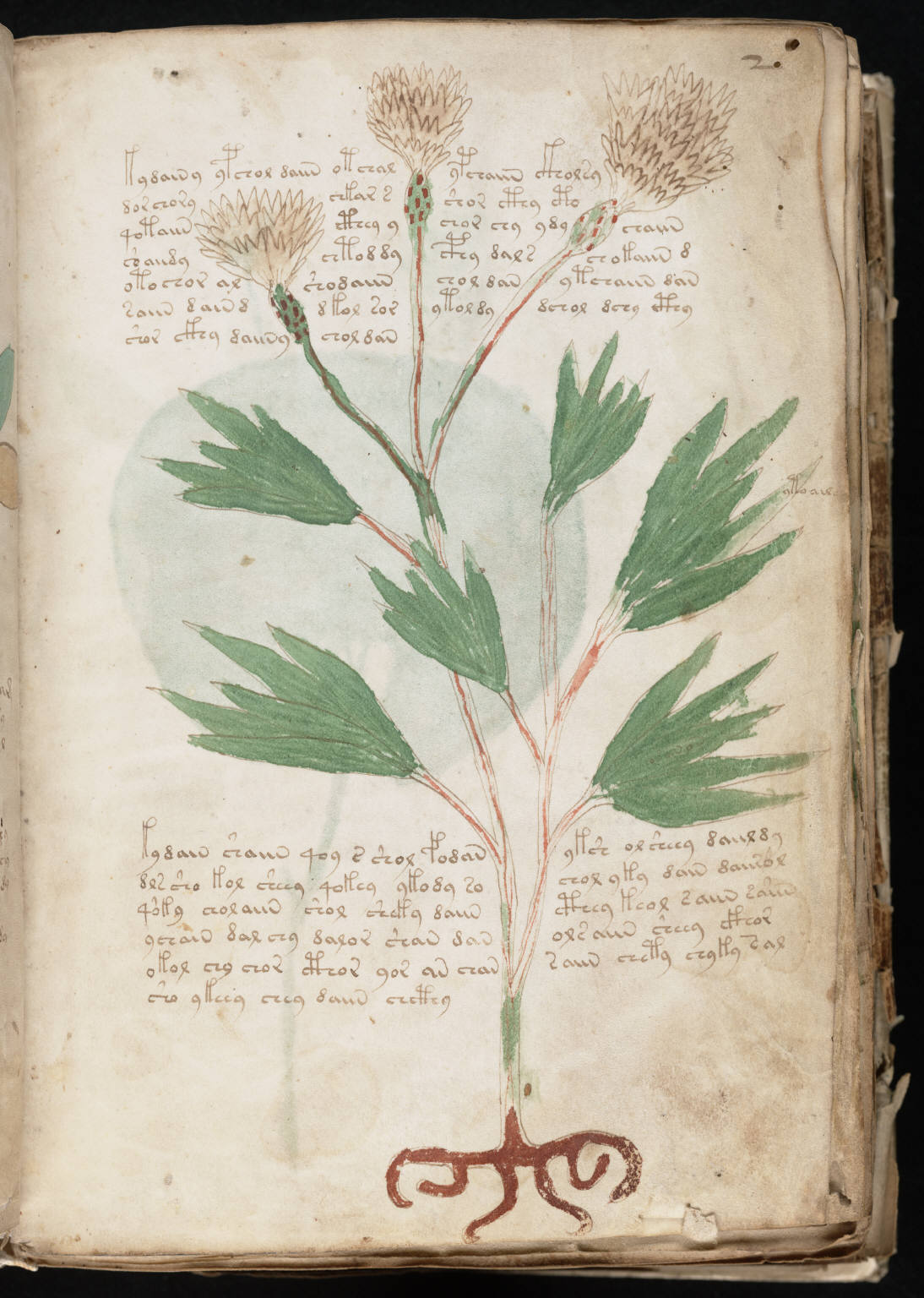
What the quire numbers show
MS 408 originally contained twenty quires. We know this because the quires were numbered — in a 15th-century notation system — during production, and those numbers survive on the surviving quires. The sequence runs 1 to 20. Quires 16 and 18 are absent. Not damaged, not partially preserved: absent. Their numbers appear in the sequence and there is no material behind them.
The eighteen surviving quires contain the manuscript’s 240 current pages — roughly 88 percent of the estimated original.
Beyond the missing quires, several specific folios within surviving quires are also absent. Folio f12 was cut out: a stub remains in the binding, which means the removal was deliberate and happened while the manuscript was bound — the folio was not simply lost. When, by whom, and for what purpose are not in the record. Folios f59 through f64 — three bifolios — are missing from the center of quire 8. The center of a quire is the join, the most vulnerable point; loss from quire centers is common in deteriorated manuscripts. Folio f74 was also cut out — another stub, another deliberate removal. The entirety of quires 16 and 18 — folios f91–f92 and f97–f98 — is absent with no stubs, no traces. Folios f109–f110 are missing from the center of quire 20.
The total missing, by scholarly estimate, is between 14 confirmed folios and a somewhat larger number depending on assumptions about original quire size.
What the stubs establish
A cut stub is different from a missing folio. Missing folios can be attributed to deterioration, to loss, to accidental damage over centuries of transmission. A cut stub is proof of deliberate removal at a defined point in the manuscript’s history — while the manuscript was still in its current bound form. The stub of f12 is visible in the current binding. Someone removed that folio intentionally.
Whether the manuscript was in its current binding when it arrived at the Collegio Romano with Kircher, when it was in Baresch’s possession, or earlier — is not established. The current binding is described as Collegio Romano period, which would place it after the manuscript’s arrival in Rome around 1665–1666. If f12 was cut while the manuscript held an earlier binding, the removal predates the Roman period.

How manuscript pages separate
The separation of pages from their parent manuscript — surviving decades or centuries in different institutions, discovered in different contexts — is a well-documented phenomenon in manuscript studies, not a theoretical possibility.
The Codex Sinaiticus, a 4th-century Greek Bible and among the earliest substantially complete New Testament manuscripts, is currently held across four institutions: the British Library, Leipzig University Library, the Russian National Library in St. Petersburg, and St. Catherine’s Monastery at Sinai. Leaves separated progressively over more than a century of rediscovery — some found by Tischendorf in 1844, some secured to Russia in 1859, some identified in 1907–1911 inside the bindings of other manuscripts at the same monastery, and twelve complete leaves discovered in 1975 beneath the floor of the St. George Chapel at St. Catherine’s.
The Book of Kells, the 9th-century illuminated Irish Gospel book, lost a bifolium (folios 335–336) at some point in its history. The bifolium was recorded as lost and subsequently recovered in 1741; two notes on folio 337r document the restoration.
The Quedlinburg Itala fragment is the case I find most directly relevant. This is a 5th-century illuminated fragment of an Old Latin Bible, probably produced in Rome in the 420s or 430s. Six of its surviving folios were discovered in the 19th century inside the bindings of later books at Quedlinburg Abbey in Germany: two in 1865, two in 1867, and one in 1887. The pages had been repurposed as binding material in the 17th century — common practice for worn or damaged manuscript leaves when newer books required reinforcement. A 5th-century manuscript page found in a 19th-century German library as binding material in a 17th-century book, after being separated from its original codex in the same century that Baresch was writing his letters to Kircher.
The parallel to a Bohemian context is not difficult to draw. It is not a claim. It is a description of what manuscripts do.
The archival implication
If a folio was removed from MS 408 before Marci sent the manuscript to Kircher in 1665–1666, it remained in Prague. Baresch held the manuscript for decades without documenting where it was stored or what condition it was in. Hořčický — if his was indeed the signature on the first folio — was imprisoned after 1611 and died in 1622, and the manuscript’s location in the years following his death is simply not in the record.
A folio separated during this period — used as binding material in a later book at a Prague institution, overlooked during nineteenth-century cataloguing, surviving undescribed in a bound collection at some ecclesiastical or administrative archive — would fit the Quedlinburg pattern precisely. I raised this possibility with a colleague then working at an institutional library in Prague. The response I received was what I would describe as mildly discouraging silence, which I have come to read as a particular kind of archival signal.
I have not established that any such folio exists. I have established that the Quedlinburg parallel is a real phenomenon and that the conditions in the Voynich provenance chain are consistent with it.
In this series
- A Manuscript Without a History
- The Emperor’s Collection and What It Means to Prove a Purchase
- Prague Provenance and the Bohemian Hypothesis
Sources
- Wikipedia — Voynich manuscript: en.wikipedia.org — quire structure, missing folios (René Zandbergen analysis cited therein).
- René Zandbergen, voynich.nu: voynich.nu — quire and folio analysis.
- Wikipedia — Codex Sinaiticus: en.wikipedia.org — folio separation across four institutions.
- Wikipedia — Book of Kells: en.wikipedia.org — bifolium loss and recovery 1741.
- Wikipedia — Quedlinburg Itala fragment: en.wikipedia.org — folios found in bookbindings 1865–1887; 17th-century repurposing as binding material.
Friday, November 12, 2021
The Quedlinburg point is worth emphasizing. The recovery there was entirely incidental — not the result of directed archival searching but of routine conservation work on later bindings. Nobody was looking for those folios when they found them. The implication is that looking might not be the right model for how such a thing would be recovered, if it exists.