A Manuscript Without a History
~ Monday, September 13, 2021 ~
Beinecke MS 408 has attracted more speculative commentary per page than almost any other document in the Western manuscript tradition. The commentary, taken as a whole, is not particularly useful. What the manuscript has attracted rather less of is careful attention to what its documentary record actually establishes — and what it does not. That is the subject of this and several subsequent articles.
I am not a cryptographer and I am not a botanist. I cannot tell you what the script is, and I am not going to attempt to identify the plants. What I can do is assess a chain of custody, read a provenance claim, and note when an assertion has documentation behind it and when it does not. That is what I intend to do here.
What has been established
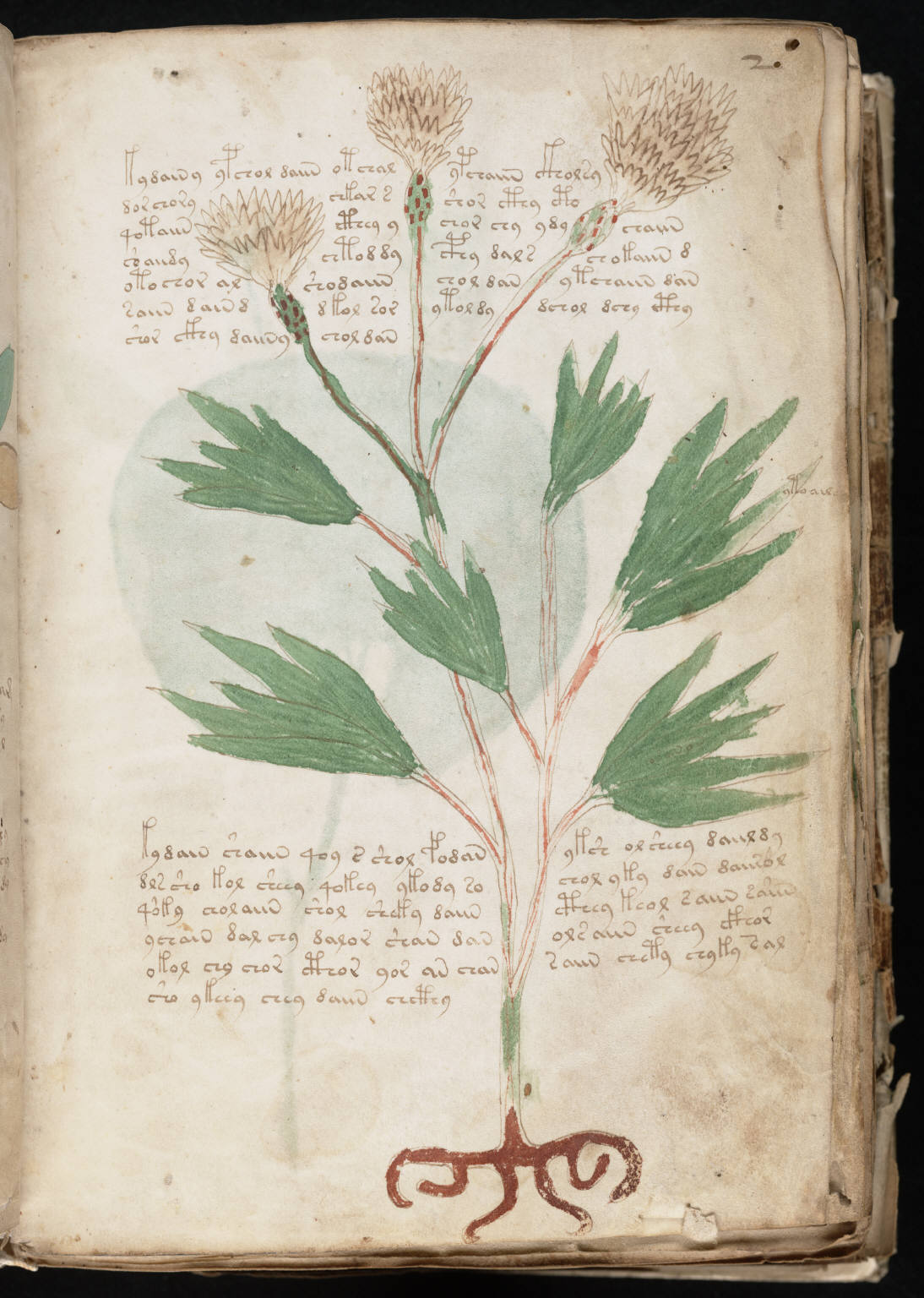
The physical facts are clear. Beinecke MS 408 — the Voynich manuscript, named for its modern discoverer — is a bound codex of approximately 240 pages, written on vellum. It is currently held at Yale University’s Beinecke Rare Book and Manuscript Library, where it has been since 1969. It measures approximately 23.5 by 16.2 centimetres. The current binding is goatskin, and is not original to the manuscript.
The radiocarbon dating was conducted in 2009 by the University of Arizona’s Accelerator Mass Spectrometry laboratory. The result: the vellum dates to 1404–1438. This is a range, not a point, and what was dated was the parchment, not the ink — meaning the manuscript could in principle have been written on older vellum. Most scholars consider this unlikely given that the pigment analysis (conducted by McCrone Associates) found iron gall ink for text and outlines, and azurite, copper-chlorine compounds, red ochre, and egg-white with calcium carbonate for the painted elements — all consistent with early fifteenth-century European production. The vellum shows no signs of having been a palimpsest.
The manuscript is organized into eighteen surviving quires of an original twenty. I will discuss the missing quires in a separate article.
The provenance chain
The documented chain of ownership begins in Prague in the seventeenth century. The earliest confirmed owner is Georg Baresch (ca. 1585–1662), a Prague alchemist and antique collector. He sent a first letter to the Jesuit polymath Athanasius Kircher in Rome in 1637, and a second surviving letter in 1639 — both requesting help deciphering a manuscript in his possession. The 1639 letter, which includes sample transcriptions from the manuscript, is the earliest known documentary mention of MS 408 in any source. It was rediscovered by researcher René Zandbergen.
On Baresch’s death the manuscript passed to Jan Marek Marci (1595–1667), Professor of Medicine at Charles University Prague, who held the position of Rector in 1662. Around 1665–1666 Marci sent the manuscript to Kircher in Rome with a cover letter. That letter — dated 19 August 1666 — survived, and Voynich found it still with the manuscript when he acquired it in 1912.
Kircher received the manuscript and appears to have done nothing with it. It remained at the Collegio Romano until Italian forces annexed the Papal States in 1870, after which it was moved into private Jesuit collections to avoid confiscation, eventually reaching Villa Mondragone at Frascati. In 1912 Voynich purchased it there in a batch of thirty manuscripts.
That is the documented chain. What the Marci letter adds — beyond the physical handover — is the claim about Rudolf II.
The Rudolf II claim
The Marci letter contains a passage worth quoting directly: “Dr. Raphael, a tutor in the Bohemian language to Ferdinand III…told me the said book belonged to the Emperor Rudolf and that he presented to the bearer who brought him the book 600 ducats.”
Raphael Sobiehrd-Mnishovsky (1580–1644) was a Bohemian lawyer, poet, and cryptographer who served in court roles under four emperors. His background in cryptography makes his identification of Roger Bacon as the manuscript’s likely author more interesting than it would otherwise be — he was not an ignorant man guessing. But Mnishovsky died in 1644, and Marci wrote in 1666. The claim as Marci records it is already at two removes: Raphael told Marci, and Raphael had heard it somewhere. Where Raphael heard it is not stated.
The claim that Rudolf purchased the manuscript for 600 ducats has never been corroborated by any independent source. Wikipedia, summarizing the current scholarly position, states plainly: “no evidence in support of this assertion has ever been discovered.” Court payment records from Rudolf’s treasury do survive, partially, in the Austrian state archives. I have not found this transaction among them. This is not proof the transaction did not occur. A 600-ducat payment to an unnamed bearer for an undescribed item is precisely the sort of record that would not survive, if it existed. The number is also exactly the kind of round figure that appears in remembered transactions that nobody wrote down at the time.
The gap before Baresch
Between the Rudolf II claim and the earliest documentary confirmation stands the figure of Jakub Hořčický z Tepence (Jacobus Sinapius, d. 1622). A faded signature — “Jacobj à Tepenecz” — appears on the first folio of the manuscript and was identified under ultraviolet light. The identification is not uncontested: the signature under UV does not precisely match authenticated examples of Sinapius’s signature from other documentary records, and the inscription appears to have been deliberately abraded at some point.
Hořčický served Rudolf II as imperial distiller, curator of the botanical gardens, and personal physician. Rudolf ennobled him in 1607. He was thus the most prominent Czech figure in Rudolf’s scientific household, which makes him a plausible owner. After Rudolf’s abdication in 1611, Hořčický was imprisoned during the political upheaval that followed, and he died in 1622.
Between his death and Baresch’s first letter to Kircher in 1637 is fifteen years. Nothing in the record accounts for where the manuscript was during this interval, or how it passed from wherever it was to Baresch’s possession.
Fifteen years is not an unusual gap in seventeenth-century Bohemian documentary history. It is, however, a gap. I will proceed from what I can establish.
In this series
- The Folios That Are Not There
- The Emperor’s Collection and What It Means to Prove a Purchase
- Prague Provenance and the Bohemian Hypothesis
Sources
- Yale Beinecke Library catalog entry: Beinecke MS 408. beinecke.library.yale.edu — physical description, provenance, dating.
- Wikipedia — Voynich manuscript: en.wikipedia.org — provenance chain, radiocarbon dating, scholarly summary.
- Wikipedia — Georg Baresch: en.wikipedia.org — dates, 1639 letter to Kircher, Zandbergen attribution.
- Wikipedia — Jan Marek Marci: en.wikipedia.org — role at Charles University, 1666 letter.
- Wikipedia — Raphael Sobiehrd-Mnishovsky: en.wikipedia.org — dates, court roles, cryptographic background.
- René Zandbergen, voynich.nu: voynich.nu — quire analysis, provenance documentation, Baresch 1639 letter rediscovery.
Wednesday, September 15, 2021
The Mnishovsky secondhand problem gets consistently underplayed in popular accounts. A claim that old, that indirectly sourced, and that lacking any corroboration in the relevant payment records would not be accepted as evidence for any other manuscript acquisition in the period. Good to see it stated plainly rather than treated as established fact with a footnote.
Friday, September 24, 2021
Do you intend to cover the Lisa Fagin Davis scribal hands work in a later article? Five hands seems to me like the most significant recent finding because it closes off the solitary-author model codicologically rather than by argument. It also changes what kind of institution you’d be looking for as the origin context.