The Jerusalem Theory and Its Problems
~ Saturday, May 15, 2021 ~
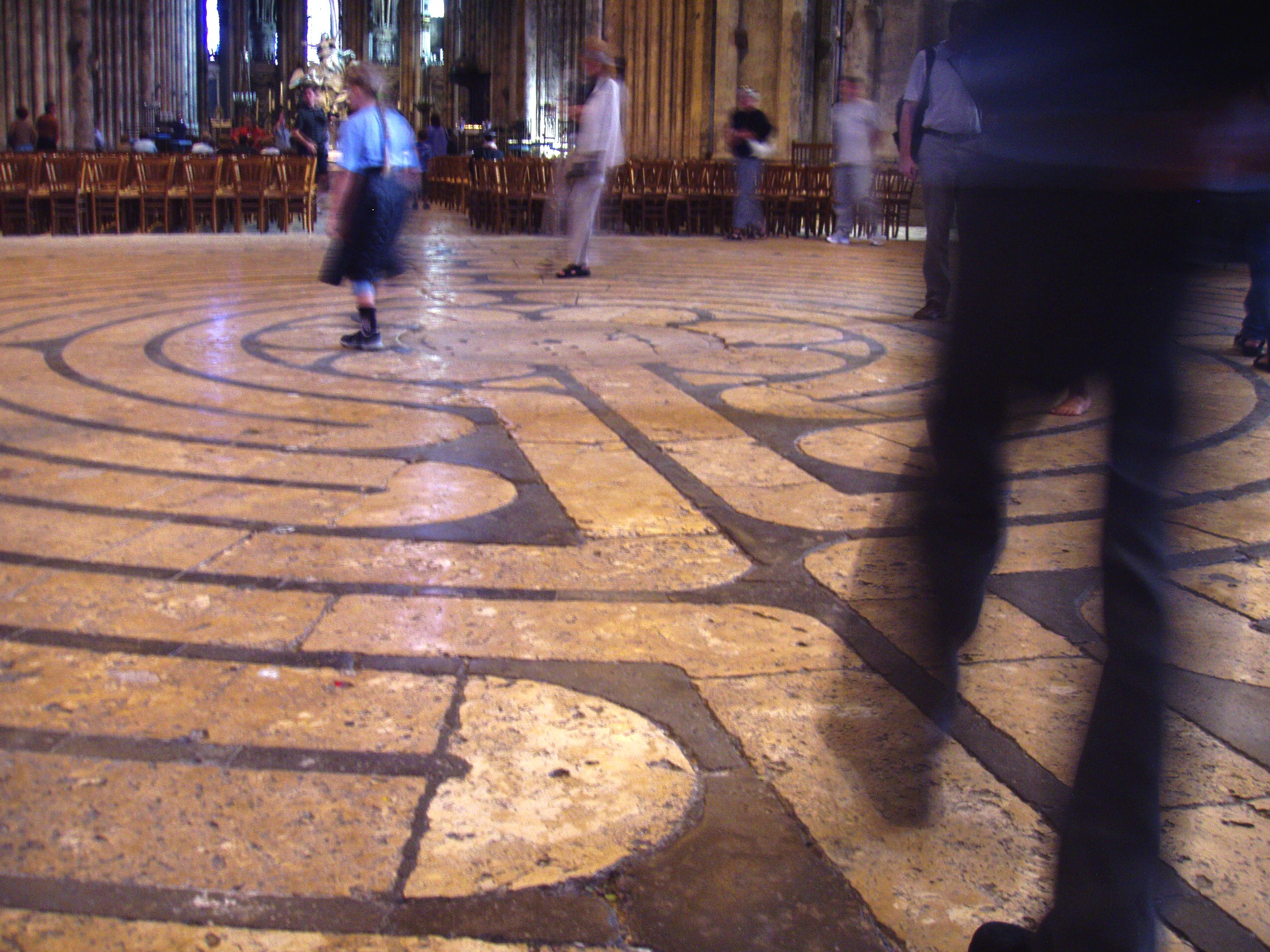
The popular account of medieval cathedral labyrinths runs as follows. After Jerusalem fell to Saladin in 1187, pilgrimage to the Holy Land became impossible or dangerous for most European Christians. The Church responded by constructing symbolic substitutes — labyrinths in cathedral naves, called chemins de Jérusalem, roads to Jerusalem. Penitents walked them, sometimes on their knees, as a proxy for the actual journey. The centre represented the Holy City. The path represented the long road to get there.
This account is coherent. It has the further advantage of being emotionally satisfying in a way that makes it easy to repeat. It has one problem: it is not documented.
The name chemin de Jérusalem first appears in 18th-century writing about the Chartres labyrinth, and may date to the 17th century. No medieval French chapter record uses it.
That is not a small gap. The labyrinth was constructed in the early 13th century. For the pilgrimage-substitute theory to be correct, someone in that century would have to have understood it that way — and recorded that understanding somewhere. The records suggest no one in that century wrote about the labyrinth at all.
What the evidence actually shows
The oldest documented penitential use of a French cathedral labyrinth — walking on knees, reciting prayers — comes from 17th- and 18th-century accounts at Reims, Arras, and Sens. This is not the 13th century. It is five centuries later, and by then the labyrinths were in the process of being demolished for disturbing services.
Lauren Artress, who revived labyrinth walking at Grace Cathedral in San Francisco in 1991 and is largely responsible for the contemporary spiritual labyrinth movement, has acknowledged that there are “no known records of anyone walking the labyrinth” at Chartres in the medieval period, and that she is aware of “no Christian writers or artists who directly refer to the labyrinth as a spiritual tool” in the medieval context. This acknowledgement, made by someone with every reason to promote the pilgrimage-substitute theory, is worth noting.
Professor Doreen Prydes, a medieval historian at the University of Notre Dame, has stated that there is “absolutely no evidence of labyrinth walking in the Middle Ages” in the penitential pilgrimage sense.
A more grounded account
What the records do support — and the best case is at Auxerre, discussed in the previous piece in this series — is an Easter liturgical use. Craig Wright’s 2001 study argues that French cathedral labyrinths were constructed for Easter Vespers: the dean walks the labyrinth while tossing a ball to the dancing canons, enacting the harrowing of hell by a warrior who enters, defeats the enemy at the centre, and emerges victorious. The warrior is Theseus; Theseus is Christ; the Minotaur is death. The bronze plaque at the centre of the Chartres labyrinth, if Challine’s description is accurate, depicted this combat directly.
This interpretation is grounded in documented medieval practice, not in a name that appears five centuries after construction. It also explains why labyrinths were installed in cathedral naves at all: they needed to be walkable, at Easter, by clergy performing a specific ritual.
What it does not explain is Chartres specifically, since no Easter ritual at Chartres is recorded. This is, again, a silence. I have been thinking about what that silence might contain.
What a symbol outlasts
The pilgrimage-substitute theory is, I think, a later reading imposed on an object whose original function had been forgotten. By the 17th century, when the chemin de Jérusalem name appears, the Easter pelota ritual had been discontinued everywhere we know it had existed. The labyrinth was still there. People needed an account of it. The Jerusalem pilgrimage — still understood as spiritually significant, still imagined as a journey one might one day make — was the nearest available frame.
This is not dishonest. It may even be correct in partial ways: the labyrinth’s designers may have had multiple meanings in view simultaneously. Chartres is a cathedral of the Virgin, built in a period when pilgrimage was its central activity. The labyrinth may have been intended to evoke the journey to Jerusalem, to enact Easter liturgy, and to encode a geometric programme all at once. These are not exclusive.
What I resist is the confidence with which the single explanation is offered. The object is old. The institution that made it is gone. The records it left behind are, for this particular object, silent. That condition deserves more respect than a smooth account provides.
A fragment I found in the Chartres chapter archive, which I will discuss in a later piece in this series, suggests a use more specific than any of the theories outlined here — and one that has not appeared in the published scholarship on the labyrinth.
In this series
- The stone path that no one recorded — the Chartres labyrinth
- The labyrinths they destroyed — Reims and Auxerre
- What the numbers say
- A rubric for the eve of Candlemas